June 23, 2026
Business, Reimagined: How a Rural Art Community Transforms Local Vision into Global Impact
June 23, 2026
Business, Reimagined: How a Rural Art Community Transforms Local Vision into Global Impact
A story of business transformation through creative process
This is a story about transformation: how vision becomes action, how creativity becomes collective momentum, and how a rural art community can create meaningful impact far beyond its borders.
Transformation rarely begins with certainty. More often, it begins with a question, a challenge, or a shared feeling that something meaningful is trying to emerge. At Malakta Art House, a rural art community rooted in creativity, collaboration, and experimentation, transformation has become both a process and a vision. This blog documents the transformation of how a rural art community in western Finland attains global impact.
The foundation of this work began with a simple but powerful understanding of a vision.
Before going back to the beginning of time, this story begins with a vision for a conference about creativity as a topic. The Global Creativity Initiative cohosted a symposium with Malakta Art House with a purpose and goal for broadening and sharing research and conversations on the topic. The symposium was a success on many levels. It was also the seed that planted this story.
Said Magdalena Lindroos, manager at Malakta Art House, "Before the symposium, I thought I understood creativity. The experience showed me a much broader perspective and helped me see its potential as a catalyst for change.
It sparked curiosity, hope, and a renewed sense of possibility for our organization."
Because visionary organizations outlast all others, Malakta engaged in a visioning session right after the symposium to set a new course. Visions are magnetic forces. They gather people, ideas, and energy around a shared purpose. In creative communities especially, vision becomes more than inspiration; it becomes infrastructure for growth, resilience, and cultural change.
This understanding shaped the facilitation work at the 2024 GCI Malakta Symposium, where a collective vision statement sparked new momentum and ultimately supported a grant that enabled creativity training for the team. What followed was not simply a workshop series, but the beginning of a larger transformation — one that reframed how a rural art community could function, communicate, and imagine its future.
At the center of this transformation is the belief that creativity is not a luxury. It is a human necessity. Creative thinking allows individuals and communities to navigate uncertainty, respond to complexity, and imagine alternatives where none previously seemed possible. It is one of humanity’s greatest survival tools, shaping innovation, resilience, and cultural evolution across generations.
The social consequences of releasing creative abilities are potentially enormous. Creativity strengthens communities by encouraging participation, collaboration, and shared ownership of ideas. It creates opportunities for people to connect across differences and contribute from their own lived experiences, perspectives, and forms of knowledge. In this way, creativity becomes deeply democratic: everyone has the capacity to contribute to transformation.
At Malakta, creativity is understood as both practical and deeply human. It is not limited to producing art objects or performances. Creativity influences how people communicate, solve problems, organize systems, care for one another, and build sustainable futures together. It asks people to think differently — not only intellectually, but emotionally and intuitively as well.
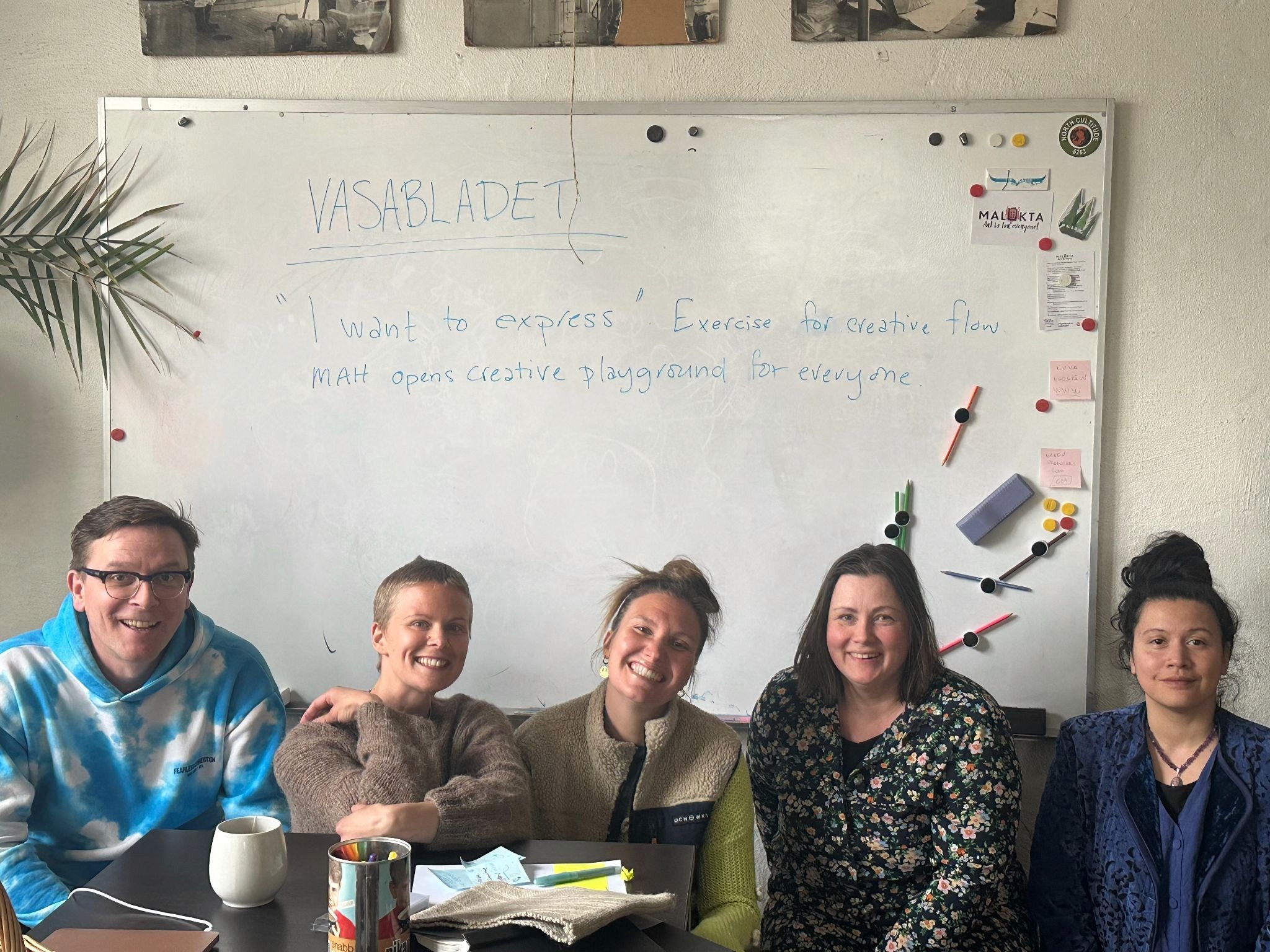
Malakta Team Feeling Good With “I want to express.”
Transformation through Creative Problem Solving also recognizes that meaningful change requires openness. New ideas often emerge gradually, through experimentation, reflection, and collaboration. Innovation rarely arrives fully formed. Instead, it grows through trust, conversation, and the willingness to remain curious long enough for new possibilities to surface.
This approach has become especially significant within the context of a rural art community. Rural creative spaces are often underestimated, yet they hold extraordinary potential for innovation because they are deeply connected to place, relationships, and lived experience. Malakta demonstrates how a local creative ecosystem can generate ideas and cultural practices with international relevance. By grounding transformation in shared vision and creative process, the community is building something that extends far beyond geography.
What is emerging is not only a stronger arts organization, but a broader model for how creativity can serve as a catalyst for motivation, connection, wellness, and social change. The vision developing at Malakta suggests that rural creative communities are not peripheral to global conversations — they are essential to them.
###
Join my newsletter list
Sign up to get the most recent blog articles in your email every week.
A story of business transformation through creative process
This is a story about transformation: how vision becomes action, how creativity becomes collective momentum, and how a rural art community can create meaningful impact far beyond its borders.
Transformation rarely begins with certainty. More often, it begins with a question, a challenge, or a shared feeling that something meaningful is trying to emerge. At Malakta Art House, a rural art community rooted in creativity, collaboration, and experimentation, transformation has become both a process and a vision. This blog documents the transformation of how a rural art community in western Finland attains global impact.
The foundation of this work began with a simple but powerful understanding of a vision.
Before going back to the beginning of time, this story begins with a vision for a conference about creativity as a topic. The Global Creativity Initiative cohosted a symposium with Malakta Art House with a purpose and goal for broadening and sharing research and conversations on the topic. The symposium was a success on many levels. It was also the seed that planted this story.
Said Magdalena Lindroos, manager at Malakta Art House, "Before the symposium, I thought I understood creativity. The experience showed me a much broader perspective and helped me see its potential as a catalyst for change.
It sparked curiosity, hope, and a renewed sense of possibility for our organization."
Because visionary organizations outlast all others, Malakta engaged in a visioning session right after the symposium to set a new course. Visions are magnetic forces. They gather people, ideas, and energy around a shared purpose. In creative communities especially, vision becomes more than inspiration; it becomes infrastructure for growth, resilience, and cultural change.
This understanding shaped the facilitation work at the 2024 GCI Malakta Symposium, where a collective vision statement sparked new momentum and ultimately supported a grant that enabled creativity training for the team. What followed was not simply a workshop series, but the beginning of a larger transformation — one that reframed how a rural art community could function, communicate, and imagine its future.
At the center of this transformation is the belief that creativity is not a luxury. It is a human necessity. Creative thinking allows individuals and communities to navigate uncertainty, respond to complexity, and imagine alternatives where none previously seemed possible. It is one of humanity’s greatest survival tools, shaping innovation, resilience, and cultural evolution across generations.
The social consequences of releasing creative abilities are potentially enormous. Creativity strengthens communities by encouraging participation, collaboration, and shared ownership of ideas. It creates opportunities for people to connect across differences and contribute from their own lived experiences, perspectives, and forms of knowledge. In this way, creativity becomes deeply democratic: everyone has the capacity to contribute to transformation.
At Malakta, creativity is understood as both practical and deeply human. It is not limited to producing art objects or performances. Creativity influences how people communicate, solve problems, organize systems, care for one another, and build sustainable futures together. It asks people to think differently — not only intellectually, but emotionally and intuitively as well.
Malakta Team Feeling Good With “I want to express.”
Transformation through Creative Problem Solving also recognizes that meaningful change requires openness. New ideas often emerge gradually, through experimentation, reflection, and collaboration. Innovation rarely arrives fully formed. Instead, it grows through trust, conversation, and the willingness to remain curious long enough for new possibilities to surface.
This approach has become especially significant within the context of a rural art community. Rural creative spaces are often underestimated, yet they hold extraordinary potential for innovation because they are deeply connected to place, relationships, and lived experience. Malakta demonstrates how a local creative ecosystem can generate ideas and cultural practices with international relevance. By grounding transformation in shared vision and creative process, the community is building something that extends far beyond geography.
What is emerging is not only a stronger arts organization, but a broader model for how creativity can serve as a catalyst for motivation, connection, wellness, and social change. The vision developing at Malakta suggests that rural creative communities are not peripheral to global conversations — they are essential to them.
###
Join my newsletter list
Sign up to get the most recent blog articles in your email every week.
Other Blogs
Check my other Blogs